|
|
The Papaya Project
|
INTRODUCTION:
Papayas from Colorado? ¡Si como no! We are
investigating yield potential of two varieties of
papayas under Colorado greenhouse conditions.
Papayas are of interest as a crop due to its sweet
taste, health benefits (packed with nutrients,
antioxidants, and used medicinally for
indigestion), and use in hair and skin products.
Regional and national demand is relatively high
and growing.
Previous research at Colorado State University
involved growing papaya in the Arkansas River
valley. Researchers were able to produce green
fruits which can be eaten or processed. |
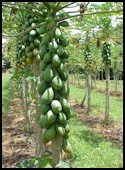
Photo courtesy of
www.AlohaSeeds.com |
| |
|
|
METHODS:
We planted 72 seeds (acquired from
Aloha Seeds, Hawaii) of each of the two varieties
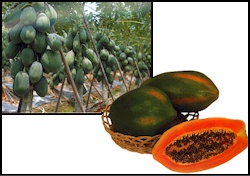
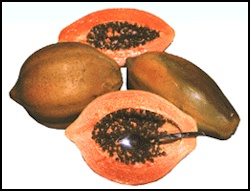
of Chinese dwarf papayas (Red Lady #786 and
Tainung #1) into Winstrip 72-cell trays on January
1, 2004. We used Sunshine No. 3 soil mixed with
10% worm castings and topped the seeds with
vermiculite. We kept the trays misted but not too
wet. |
| |
 |
|
 |
|
Red Lady #786 |
|
Tainung #1 |
|
Photos courtesy of www.AlohaSeeds.com
|
| |
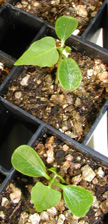
| Seeds began germinating on January 20, 2004 .
The seeds in the cells on the perimeter of the
tray germinated first indicating soil warmth is a
factor. |
| |
 |
|
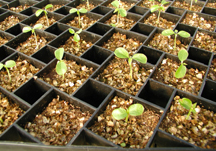
Germinating papaya seedlings
|
| |
|
|
 |
|
Approximately 15 of the seedlings seemed to
have a virus, the roots were healthy but the plant
wilted and died. The remaining seedlings (33
Tainung and 35 Red Lady) were transplanted into
3-gallon pots into a mixture of coir and perlite
on March 12, 2004. We began fertilizing the
seedlings with ammonium sulfate (20-0-0) and then
switched to Peters 15-5-15 Cal-Mg to keep the pH
from going to low (optimum pH for papayas is
between 6.5 to 7.0). Note that the papayas are not
being grown organically. |
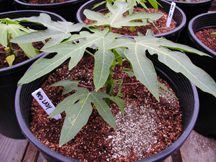
Red Lady papaya plant |
|
|
| |
| The papayas began blooming mid-summer, 2004.
Unfortunately many of the flowers were dropping,
probably due to insufficient nutrients and/or
water. We switched from fertilizing once a week to
a constant feed and watered more frequently. The
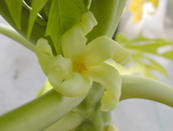
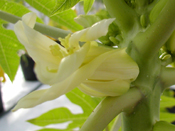
papaya plants produced hermaphroditic and female
flowers. As of November 2004, the female flowers
began producing fruits. Fruits can be grown
without pollination but will be smaller. The
hermaphroditic plants are self-pollinating, as the
stigma grows through the developed stamens. Those
plants began producing fruits in March of 2005.
|
| |
 |
|
 |
|
Hermaphroditic Flower |
|
Female Flower |
| |
|
|
| On December 3, 2004, all papaya plants were
moved into a newly renovated quonset greenhouse
with a heated floor wherein warm water runs
through tubing under a pea gravel floor. The
papayas thrived with the bottom heat. Minimum
night temperatures were set to 55 degrees F (below
that the fruits and flowers abort) and the maximum
ambient temperature in the day was 85 degrees F.
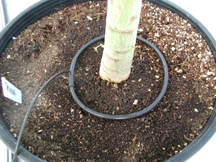
An irrigation system was also set up with
individual watering rings for each plant. |
|
 |
| |
|
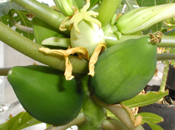
Papaya Fruits |
| |
|
|
 |
|
 |
|
Papayas in the quonset greenhouse
|
|
Irrigation system |
| |
|
|
| |
 |
|
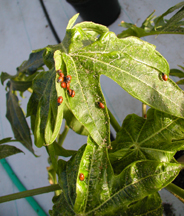
A few insect pests affected the papayas.
Two-spotted spider mites were troublesome, as well
as aphids. Fungus gnats were also a problem. We
introduced Hypoaspis miles (predatory
mites) to the soil to control the fungus gnats and
Feltiella acarisuga (also a predatory
mite) to control the two-spotted spider mite.
Lacewings were introduced unsuccessfully (they
didn't lay eggs as we had hoped), and so we
resorted to introducing adult ladybird beetles
which dropped the aphid population quickly.
Growth of the papaya plants is recorded below
(see Table 1). The plants grew quickly after we
increased the fertilizer rate in the spring of
2005. Stem girth was measured near the base of the
plant at the soil. Height was measured from soil
level to the top of the upper leaves. We
transplanted the plants into 7- gallon pots in
April of 2005. |
| |
Ladybird beetle release for aphid control
|
|
| |
|
|
|
| Table 1. |
12/3/04 |
3/5/05 |
3/13/06 |
|
Variety |
avg. height (cm)
|
avg. girth (cm)
|
avg. height (cm)
|
avg. girth (cm)
|
avg. height
(cm) |
avg. girth (cm)
|
| Tainung |
100 |
3.7 |
156 |
7.4 |
192 |
7.6 |
| Red Lady |
66 |
3.5 |
125 |
5.8 |
130 |
6.7 |
| Table 2. Yield data
from 7/22/05 to 9/30/05 |
| Variety |
# fruit/plant
|
lbs./plant |
lbs./fruit |
| Tainung |
1.77 |
0.89 |
0.5 |
| Red Lady |
3.76 |
2.33 |
0.62 |
 |
|
We picked the first ripening fruit
on July 22, 2005. Red Lady appeared to give higher
yields on a shorter plant. We believe that the
overall yields from our study were somewhat low
and the first fruiting was late due to
fluctuations in our fertilization rates and
frequency. |
 |
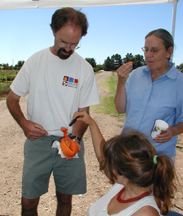
Taste Testing |
|
|
Red Lady
Papayas |
It was determined that with adequate light, heat, and
fertilization, papayas can indeed be grown in
greenhouses in Colorado, however the commercialization
of papaya as a greenhouse crop is unlikely due to the
slow rate of maturation and high cost of heating in the
winter.
Last updated 3/16/06 | |
